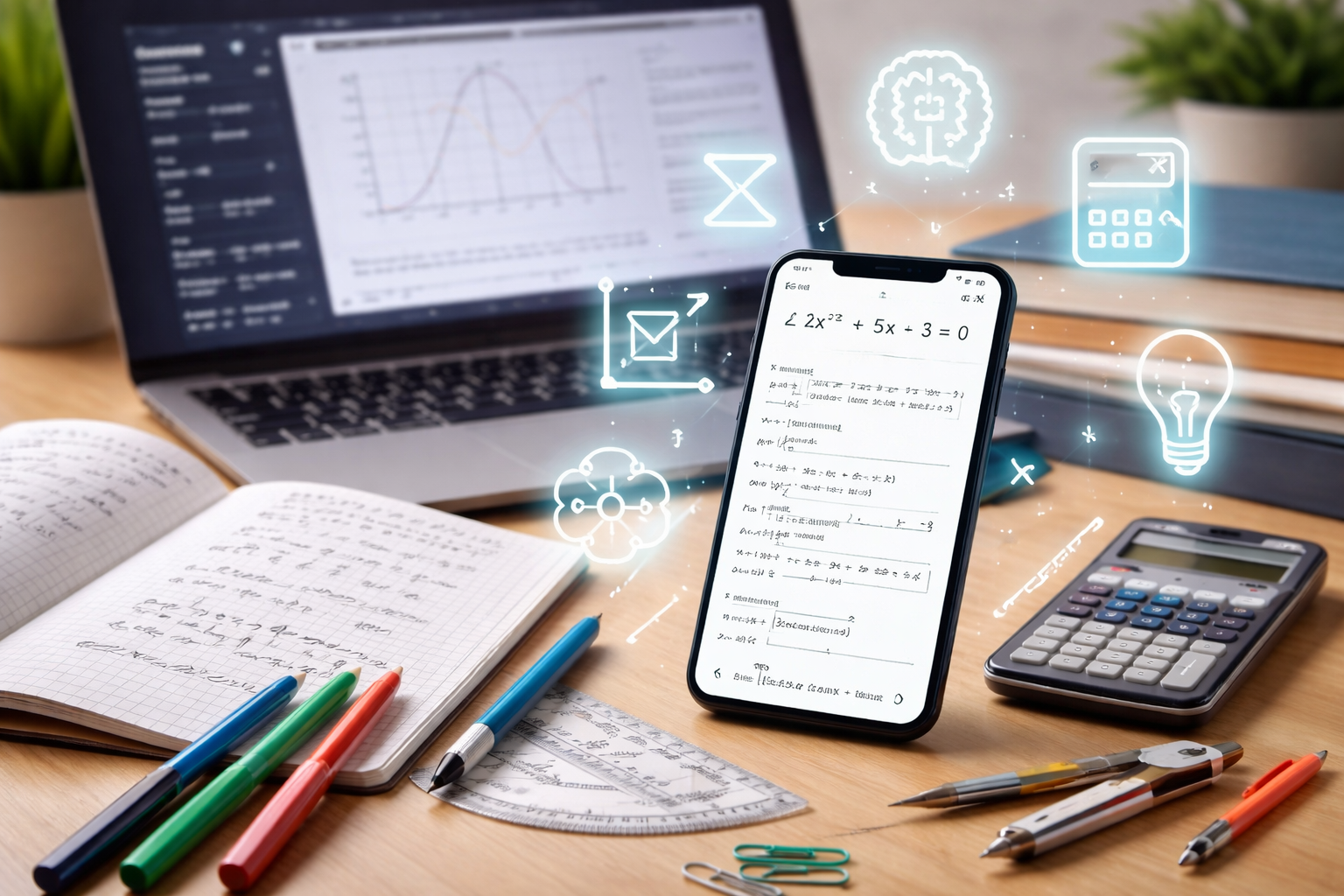
Artificial intelligence (AI) has rapidly transformed how students, teachers, and professionals approach learning and problem-solving. One area where this impact is especially visible is mathematics. Traditionally, solving math problems required textbooks, classroom instruction, and often long hours of practice.
Today, AI-powered tools are changing that experience by offering instant solutions, step-by-step explanations, and personalized guidance. These tools are not just calculators—they are intelligent systems designed to understand problems, break them down, and teach users how to arrive at the correct answer. As a result, AI tools for solving math problems are becoming essential companions in modern education.
At their core, AI math tools combine machine learning, natural language processing, and symbolic reasoning to interpret mathematical questions. Whether a student inputs a simple arithmetic problem or a complex calculus equation, these tools can analyze the structure of the problem and provide accurate results.
Many of them also include visual recognition features, allowing users to take pictures of handwritten or printed equations and receive instant solutions. This has made learning math more accessible, especially for students who may struggle with traditional teaching methods.
Top AI Tools for Solving Math Problems
Photomath
This app allows users to scan math problems using their smartphone camera. Once scanned, it not only provides the answer but also shows detailed steps explaining how the solution was reached. This step-by-step breakdown is particularly helpful for students who want to understand the logic behind the answer rather than just memorizing it. Photomath supports a wide range of topics, including algebra, geometry, trigonometry, and calculus, making it a versatile tool for learners at different levels.
Wolfram Alpha
Unlike basic calculators, Wolfram Alpha functions as a computational engine capable of solving highly advanced mathematical problems. It can handle everything from solving equations and plotting graphs to performing statistical analysis and symbolic computations. What sets it apart is its ability to provide in-depth explanations and multiple solution methods. For university students and professionals dealing with complex mathematical concepts, Wolfram Alpha is an invaluable resource.
Microsoft Math Solver
This tool supports both typed and scanned inputs, making it flexible for different user preferences. It covers a wide range of topics, from basic arithmetic to advanced calculus. One of its standout features is the inclusion of learning resources such as video tutorials and similar problem examples. This helps users not only solve a particular problem but also improve their overall understanding of the subject.
Symbolab
Symbolab specializes in step-by-step explanations for algebra, calculus, and other advanced topics. It allows users to explore different solution paths and understand the reasoning behind each step. This makes it especially useful for students preparing for exams or trying to master difficult concepts.
Khan Academy
While it may not function as a direct problem solver like other apps, Khan Academy offers personalized learning experiences. It provides adaptive exercises and instructional videos that help students build strong mathematical foundations.
One of the key advantages of AI math tools is their ability to provide instant feedback. In traditional learning environments, students often have to wait for teachers to review their work before identifying mistakes. With AI tools, feedback is immediate, allowing learners to correct errors and understand concepts in real time. This not only saves time but also enhances the learning process by reinforcing concepts as they are being practiced.
Another significant benefit is accessibility. AI math tools are available on smartphones, tablets, and computers, making them easily accessible to a wide audience. This is particularly important in regions where access to quality education resources may be limited. By providing free or affordable solutions, these tools help bridge the gap and ensure that more students have the opportunity to learn and succeed.
Despite their many advantages, AI math tools also come with certain limitations. One concern is over-reliance. Students may become dependent on these tools and use them to get answers without truly understanding the underlying concepts. This can hinder long-term learning and problem-solving skills. To address this, educators often encourage students to use AI tools as a supplement rather than a replacement for traditional learning methods.
Another challenge is accuracy in highly complex or ambiguous problems. While AI tools have improved significantly, they may still struggle with certain types of questions, especially those requiring deep conceptual understanding or creative problem-solving. Users should therefore verify solutions and use multiple resources when dealing with critical tasks.
Privacy and data security are also important considerations. Many AI tools require internet access and may collect user data to improve their algorithms. It is essential for users to be aware of privacy policies and choose reputable platforms that prioritize data protection.
Looking ahead, the future of AI in mathematics education is promising. As technology continues to advance, we can expect even more sophisticated tools capable of understanding context, providing personalized tutoring, and adapting to individual learning styles.
In conclusion, AI tools for solving math problems have revolutionized the way people learn and interact with mathematics. By combining traditional learning methods with AI-powered solutions, students can develop a deeper understanding of mathematics and build the skills needed for academic and professional success.